Thursday, September 1, 2011

Dominus (1994)

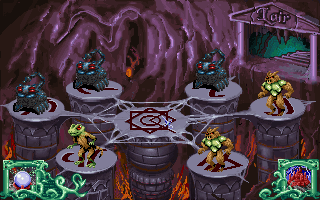
I was very surprised I didn’t know of this game earlier. It’s a good and complex strategy game that will be appreciated also by the people who’re not in the hard core strategy.

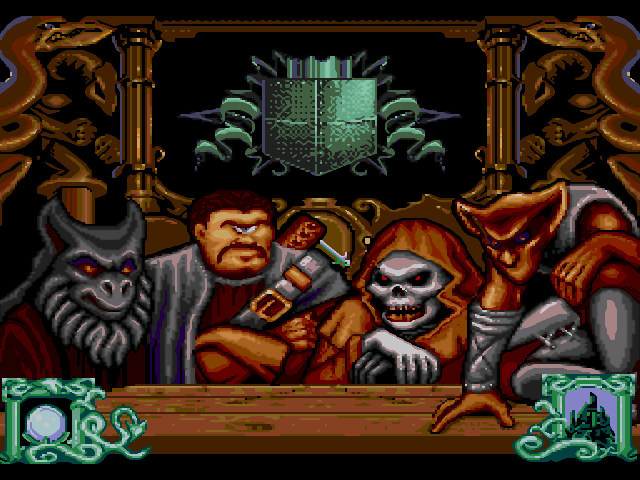
You are in your library when you get the important message that your realm is in danger. Enemy hoards are approaching and are planning to attack you. At your command you have four generals (weird looking animal like creatures) with their armies. Your castle is in the middle of the map and there are several provinces surrounding it.

To prevent the enemies from storming your castle, you can place traps in the provinces they need to pass. You can also deploy armies of monsters to fight off the enemies. Don’t forget, that in such a case you need to gather more armed forces afterwards, or your castle may be defenseless (if too many soldiers die). You can even join the battle yourself (by clicking the chariot icon when watching a battle).

You can kill your enemies, or try to capture them (the best way is with traps). My favorite part of the game is interrogation. There’s a dungeon in your castle, where you take your prisoners too (and you know what wicked and highly painful things were done to prisoners in dungeons). This way you can get information. There’s a better use for the prisoners though. You can mix them together to create heroes (making a mutant cocktail).

The game also lets you come up with magic spells. You have an entire alchemist’s laboratory at your disposal and you get to mix things up, or go through the spells you already know in order to enhance your magic capabilities. Magic is very useful in the art of trap-building and very helpful in many other aspects. You can also have your armies search for magic (or traps) in the provinces.

So far it all sounds very diverse and exciting (it actually is), but the game has a few downsides too. I especially dislike the battle option. If you decide to join the battle yourself (you’ll arrive at the battlefield in a cool flying chariot). To move around hold SHIFT and move him with the mouse.

Also I’d appreciate a bit more time before the initial attack (you don’t even have the time to set any traps). You’d think that you’d have a bit more time to prepare before the first attack (they didn’t make you their sovereign on the eve of battle).

Apart from that, the game features very good graphics, full mouse control, smooth animations and a solid sound (although the tune may become slightly irritating). All in all it’s a good game that I can strongly recommend, but it’s not easy to master.

Link


Wednesday, August 31, 2011

Mega Lo Mania (1992)

This game's name reflects its nature pretty accurately. It is truly megalomaniacal when it comes to addictiveness or the time it requires from the player. It has been ported to all most popular gaming platforms that existed in the early ninetees. These include Amiga, Genesis, Atari ST and PC. Some may argue that the versions differ in quality due to better graphics or more intuitive controls, but I believe its the gameplay that counts the most, and it is the same in all versions.

So, you're probably wondering what is this game is about in the first place. I'm not going to retell the whole introduction sequence here, but I'll give you the basics. You are a god and you have a designated tribe which you control. But you are not alone; there are also 3 other gods controlling their tribes on the same planet, and you are fighting the other gods so that your tribe would become the most powerful one in the world. You will oversee the development of your tribe from the time of the wheel all the way to the discovery of nuclear power.

The game is split into epochs. Each epoch consists of several missions that you must accomplish in order to get a secret word for the next epoch. This basically means that you will have to complete an entire epoch before you can actually „save“ your game. This can be pretty frustrating as an epoch can consist of many missions, so I suggest you start playing bigger ones in the morning :) There is another aspect of this game you should be careful about. Each epoch you are granted 100 people, and for each mission you choose a number of people you will start playing with. You should carefully choose this as it is important that you use as little people as possible for easier missions, in order to save them for the harder ones.

In each mission you will have to watch over 5 things. These are research, attack, defence, breeding and mining. The object of the game is to assign the people in the best possible way in order to achieve maximum efficiency. The more people you have working in a certain area, the faster this area develops. So, the more non-workers you have, the faster your population will grow, the more people you have researching, the faster you will get new inventions and so on. This might sound easy, but its extremely challenging. With time, you will gain confidence and try to start the missions with insanely small amounts of people, so you can basically make the game as challenging as you want it to be.

But enough with the spoilers. I suggest you give it a shot and see how you do. This game is very mentally challenging and if you give it some time to get accustomed to, it will keep you hooked for months to come. The concept of Mega Lo Mania is very original and intelligent, and it has been flawlessly executed in form of a game. The only reason why I give it a 4 mark is because I find the mission saving incapability very irritating, but still, who could resist playing god, even for a day!


DOWNLOAD MEGA LO MANIA

Tuesday, August 30, 2011

Heroes of Might & Magic 3 (1991)

Your typical game developer specializes at a particular genre, leaving New World Computing as an uncommon exception that excels on not one but two fronts. Best known for its long running Might and Magic role-playing series, New World has since created the offshoot Heroes of Might and Magic turn-based strategy series, which has nearly eclipsed its role-playing progenitor with the sheer amount of critical and popular acclaim it's earned. It's no coincidence - the Heroes formula is one of the most brilliant strategy game designs ever conceived, with its careful blend of micro- and macromanagement within a distinctive fantasy setting.

And so, the big question with Heroes of Might and Magic III is whether the formula is good enough to hold up three games in a row. After all, while Heroes III overhauls the appearance and otherwise expands upon its predecessors, its gameplay remains fundamentally similar. Nevertheless, spending even a short time with the game quells any doubt that it's anything but an excellent sequel and a first-rate strategy game in its own right. But you'll notice its new look before everything else.

The first two games were especially notable for their colorful storybook-style graphics, which lent either one a quirky sense of humor in spite of the epic subject. You'd witness hundreds of peasants being slaughtered by, for instance, a pack of minotaurs. But because both the peasants and the minotaurs looked silly, and because their numbers were graphically abstracted onscreen with just a single unit representing the army, it was difficult to take the combat too seriously.

Even though it plays about the same, a veteran of the first two Heroes games will initially suspect that Heroes of Might and Magic III is a departure from the series because of its face-lift. Specifically, it tries to look a little more serious. Many of the units seem more dangerous than before, and at first, the look can put you off. The 3D-rendered units seem to lack some of the charm and character of the previous games, in part because the higher resolution graphics mean all the creatures appear smaller onscreen than before. Still, further inspection reveals that the old flame still burns - just take a look at the new units like the devils (complete with scythes, ram horns, and sideburns) or the behemoths (lots of hair, teeth, and claws) and you'll see that the series still retains its trademark sense of humor.

While not all of the monsters in Heroes III look interesting, most of its graphics are beautiful, especially for a genre that typically neglects its appearance for the sake of gameplay. Heroes of Might and Magic III sounds even more impressive, with incredible and well-suited orchestral themes for each castle, although the operatic vocals from Heroes II are conspicuously absent.

The turn-based gameplay has you recruiting mercenary heroes, whom you then guide about an overhead map jam-packed with resources, treasure, magical artifacts, mysterious landmarks, monsters, and more. Using the resources your heroes acquire, you augment your towns so that they can produce more powerful units, or still more resources. Meanwhile your heroes gain experience, skills, and spells, and you put them in command of the largest armies that you can afford in an ultimate effort to defeat the enemy mercenaries looking to conquer you first. As your heroes earn experience through combat and exploration, you'll want to utilize some for castle sieges, while others will make far better scouts or magic users. All the while, you need to balance resources between recruiting new troops and heroes, and building new facilities in your castles.

Half the game is spent exploring and building, and the other half is spent in battle. The overhead map switches to a side view when you engage in combat, at which point you must command your various creatures against their enemies, taking turns moving unit stacks one by one depending on their speed. You can have up to seven types of creatures serving under a hero (as opposed to five in the previous games), with seven unique creatures available in each of the eight castles. Every creature can also be upgraded, making it more powerful yet more expensive to recruit. Each castle is meticulously balanced, and although the units roughly correlate between castles, most of them are unique. In fact, many of the creatures (both old and new) now have special abilities; archangels can resurrect their fallen comrades, unicorns create a defensive anti-magic aura, and cavaliers deal more damage if they charge their target. Combat plays out simply, but a great deal of complexity lies beneath the surface, as your hero's attributes and spells tend to sway the course of a battle.

The single player game spans six campaigns detailing the war to claim the kingdom of Erathia from the perspective of good, evil, and mercenary leaders alike. The story isn't played up too much, but the campaign missions themselves are well designed and appear deceptively small. In fact, many contain subterranean caverns as well as the usual overworld territory, often demanding hundreds of turns across many hours of play. And if you can finish the campaigns, you still have dozens of single player maps to try, with the promise of many more to come thanks to the map editor included with the game. Meanwhile, Heroes III is a much better multiplayer game than its predecessors, as you can scroll around the map and review your forces when it's not your turn.

Heroes of Might and Magic III doesn't alter the formula set forth by its ancestors, but represents a refinement and improvement on caliber with the finest sequels ever released. The promise of much more of everything - heroes, castles, creatures, artifacts, skills, spells - is gracefully accomplished so as to accentuate the game's complexity, style, and strategy without making it feel excessive. Much like its predecessors, Heroes of Might and Magic III successfully combines a number of elements that are enjoyable and accessible on their own, but when combined and weighed as a whole, they add up to a game that's both entertaining and rewarding.


DOWNLOAD HEROES OF MIGHT AND MAGIC III

Monday, August 29, 2011

Dragon's Lair II: Time Warp (1991)

Dragons Lair is a legend among video games. When it arrived in the arcade scene it was like nothing you've ever seen before: The game was an interactive cartoon, where Dirk the Daring, a dashing young knight, enters the evil Singe the Dragon's castle to rescue the beatiful princess Daphne. Despite the flawed gameplay, it was a hit. A beatiful hit that is.

How does the DOS-game fair? Well enough. The dos version, titled "Dragon's Lair II - Escape from Singe's Castle" is a sequel of the original released only for the home computers. Despite this, its still the same; Dirk goes in the Castle, dodges traps and saves the girl, all in glorious dos-animations. Its understandable that you cant get the same quality as in the arcade Dragon's Lair games, but its still a good try.

So how does Dragon's Lair actually play? Well, its kind of like Interactive cartoon. You have to move the Dirk out of the harms way or help him to take out the baddies. In game words, you have to choose your action with joystick before Dirk gets killed. And mark my words: If you dont do anything or you do something wrong, Dirk really gets killed. There's no different ways to survive the scenes: You have to do it right.

This makes the gameplay very flawed. Many times when playing this, you do something wrong and when you're out of lives, you start out from the beginning. Its a huge game of trial-and-error. Altough some of the times there's something flashing, as a sign what you should do, most of the players usually end up guessing the next action.

Despite the gameplay flaw, Dragon's Lair still has that charm. Okay, its not the same charm as in the arcades, but charm nonetheless. I think the best way to enjoy the game is to finish it, memorize the whole game and replay it or play it with a walktrough.

Oh, and Princess Daphne is a one hot chick.

DOWNLOAD DRAGON'S LAIR II: TIME WARP

Heroes of Might & Magic 3 (1991)

Your typical game developer specializes at a particular genre, leaving New World Computing as an uncommon exception that excels on not one but two fronts. Best known for its long running Might and Magic role-playing series, New World has since created the offshoot Heroes of Might and Magic turn-based strategy series, which has nearly eclipsed its role-playing progenitor with the sheer amount of critical and popular acclaim it's earned. It's no coincidence - the Heroes formula is one of the most brilliant strategy game designs ever conceived, with its careful blend of micro- and macromanagement within a distinctive fantasy setting.

And so, the big question with Heroes of Might and Magic III is whether the formula is good enough to hold up three games in a row. After all, while Heroes III overhauls the appearance and otherwise expands upon its predecessors, its gameplay remains fundamentally similar. Nevertheless, spending even a short time with the game quells any doubt that it's anything but an excellent sequel and a first-rate strategy game in its own right. But you'll notice its new look before everything else.

The first two games were especially notable for their colorful storybook-style graphics, which lent either one a quirky sense of humor in spite of the epic subject. You'd witness hundreds of peasants being slaughtered by, for instance, a pack of minotaurs. But because both the peasants and the minotaurs looked silly, and because their numbers were graphically abstracted onscreen with just a single unit representing the army, it was difficult to take the combat too seriously.

Even though it plays about the same, a veteran of the first two Heroes games will initially suspect that Heroes of Might and Magic III is a departure from the series because of its face-lift. Specifically, it tries to look a little more serious. Many of the units seem more dangerous than before, and at first, the look can put you off. The 3D-rendered units seem to lack some of the charm and character of the previous games, in part because the higher resolution graphics mean all the creatures appear smaller onscreen than before. Still, further inspection reveals that the old flame still burns - just take a look at the new units like the devils (complete with scythes, ram horns, and sideburns) or the behemoths (lots of hair, teeth, and claws) and you'll see that the series still retains its trademark sense of humor.

While not all of the monsters in Heroes III look interesting, most of its graphics are beautiful, especially for a genre that typically neglects its appearance for the sake of gameplay. Heroes of Might and Magic III sounds even more impressive, with incredible and well-suited orchestral themes for each castle, although the operatic vocals from Heroes II are conspicuously absent.

The turn-based gameplay has you recruiting mercenary heroes, whom you then guide about an overhead map jam-packed with resources, treasure, magical artifacts, mysterious landmarks, monsters, and more. Using the resources your heroes acquire, you augment your towns so that they can produce more powerful units, or still more resources. Meanwhile your heroes gain experience, skills, and spells, and you put them in command of the largest armies that you can afford in an ultimate effort to defeat the enemy mercenaries looking to conquer you first. As your heroes earn experience through combat and exploration, you'll want to utilize some for castle sieges, while others will make far better scouts or magic users. All the while, you need to balance resources between recruiting new troops and heroes, and building new facilities in your castles.

Half the game is spent exploring and building, and the other half is spent in battle. The overhead map switches to a side view when you engage in combat, at which point you must command your various creatures against their enemies, taking turns moving unit stacks one by one depending on their speed. You can have up to seven types of creatures serving under a hero (as opposed to five in the previous games), with seven unique creatures available in each of the eight castles. Every creature can also be upgraded, making it more powerful yet more expensive to recruit. Each castle is meticulously balanced, and although the units roughly correlate between castles, most of them are unique. In fact, many of the creatures (both old and new) now have special abilities; archangels can resurrect their fallen comrades, unicorns create a defensive anti-magic aura, and cavaliers deal more damage if they charge their target. Combat plays out simply, but a great deal of complexity lies beneath the surface, as your hero's attributes and spells tend to sway the course of a battle.

The single player game spans six campaigns detailing the war to claim the kingdom of Erathia from the perspective of good, evil, and mercenary leaders alike. The story isn't played up too much, but the campaign missions themselves are well designed and appear deceptively small. In fact, many contain subterranean caverns as well as the usual overworld territory, often demanding hundreds of turns across many hours of play. And if you can finish the campaigns, you still have dozens of single player maps to try, with the promise of many more to come thanks to the map editor included with the game. Meanwhile, Heroes III is a much better multiplayer game than its predecessors, as you can scroll around the map and review your forces when it's not your turn.

Heroes of Might and Magic III doesn't alter the formula set forth by its ancestors, but represents a refinement and improvement on caliber with the finest sequels ever released. The promise of much more of everything - heroes, castles, creatures, artifacts, skills, spells - is gracefully accomplished so as to accentuate the game's complexity, style, and strategy without making it feel excessive. Much like its predecessors, Heroes of Might and Magic III successfully combines a number of elements that are enjoyable and accessible on their own, but when combined and weighed as a whole, they add up to a game that's both entertaining and rewarding.

DOWNLOAD HEROES OF MIGHT AND MAGIC III

Heroes of Might & Magic I (1995)

If some of you, like me, have become familiar with Heroes of Might and Magic through one of the later titles in the series, then the resemblance between them will be quite clear. Everything that is typically found in HoMM games is here: Heroes, creatures, spells, towns to control and expand, and a world to discover with plenty of monsters and opposing armies to fight.

Heroes stormed onto the scene in 1995 for both DOS and Windows. The version discussed here is the DOS version, which lacks the world-editing tool of the Windows version. However, I don’t expect anyone to start creating new maps for such an old game, so that’s not a problem.

In Heroes, you have the choice to play either a single map or a campaign. Sadly, there is only one campaign. The single maps are much more interesting. No fewer than eighteen shipped with the game, promising to keep you playing for hour upon hour. The replay factor is high since you can choose from four different species of creatures to play with. The difficulty rating is adjustable, and the maps are listed with a difficulty rating as well. It’s all very user-friendly.

This makes it all the more strange that the campaign lacks any difficulty settings. You can choose from among the four species again but that is all. The campaign itself is nothing but a prearranged series of single maps, which is disappointing. There is a story interwoven between the maps by short texts, but it has little relation to the game. The campaign in itself is too difficult for the casual player and I had no fun playing it. I soon found myself going back to the single maps.

In combat, you control armies that explore the map and do battle with other armies in a separate semi-3D environment. Towns contain buildings that produce creatures. The fights are fought in a Master of Magic style, with creatures stacked in groups to fight. You never see the individual creatures, only their overall representation.

The game looks far older than its ten years. For some reason, 3DO, the developers of Heroes, never managed to hire some decent graphics artists. If I had been told that this game was released fifteen years ago, I would have believed it. The colors might as well have been restricted to sixteen, and the animation is laughable. This is not a flaw that hurts the game terribly, but there is one that does: balance. Heroes has none. When you control certain species, the game is much tougher than with others. Specifically, the mountain species is a lot stronger than any other because their creatures are superior. This flaw would haunt the series during its entire life in all its incarnations, but it is especially bad in this version.

I have saved the most remarkable aspect of HoMM for last: its multiplayer support. In 1995, only a few games could boast a multiplayer option at all, and HoMM has not one but four. Modem, Direct Connect, Network, and even Hot Seat modes are all included, making the life span of the game even longer. After beating the campaign and all the single maps, you can challenge your friends even if you do not own a modem or two computers.

Sadly, 3DO went bankrupt in 2003, and the license is now held by Freeverse.

All in all, HoMM is a game well worth playing even today, and if a friend comes over, you can have some nostalgic fun with its multiplayer option.

DOWNLOAD HoM: I

Frontier: Elite 2 (1993)

Frontier was the follow up to the supposedly classic "Elite". Although some
magazines thought that it wasn`t anywhere near as good (I recall AP calling
it a "damp squib") as the original (which I don`t think was that great
anyway), others thought that it was a milestone in gaming, with endless
possibilities - truly a wonder game. I fall somewhere in between the two.
First off, Frontier is better than Elite. I don`t see how people could
disagree with this. People who enjoyed Elite did so not because of the space
ship fighting, because this was so simplistic that it could hardly be the
main reason. No, that merely complemented the game. The main part was the
freedom to do what you wanted, how you wanted. Logically, all that Frontier
did was to expand on this, and increase the believability of the Elite
universe. Firstly, now you have the Empire and the Federation, sort of like
the Romulans and Starfleet out of Star Trek. These two bodies generally stay
out of each other`s way. You can choose to complete tasks for them, for a
fee of course, ranging from simple courier missions to full-on seek and
destroy mission. In fact, there were rumours that I recently read in
c.s.a.games that there were other missions as well in the game, only they
never made it due to deadlines. Yep, Frontier, in true Pagestream 3 fashion,
suffered from the perennial problem, deadline day. Just like SWOS. Only
Sensi Soft at least made amends by releasing a fix disk, whereas David
Braben elected not to, and just left it to us to discover the bugs, and make
up reasons for their existance. For instance, travel to 655 light years
away, and you`ll be able to jump there. This is a bug, no two ways around it
in my book. Some people, however, call this a "wormhole", in a vain attempt
to maintain the believability of the Elite universe. Also, this benefits Mr
Braben as he is in fact commended for including a really clever feature, as
opposed to being remanded for not bug testing enough. Bah. Thankfully, this
foolishness did not continue in First Encounters, when Braben pushed his
luck too far by creating a mishmash game based around some incredible bugs,
as opposed to the other way around. But, I`m being a bit too picky, because,
when all is said and done, the bugs aren`t too bad, and they certainly don`t
stop the game being playable or anything.
Now, back to the game! Oh, yes, comparing Elite with Frontier. Whereas Elite
had five or six missions in the game (which were carefully hidden), Frontier
has about ten or so for the military, plus another twenty or so such as
passanger carrying that you broker with the civilians in the game.
I`m not going to bother illustrating every way Frontier is bigger than
Elite. But if you take a feature of Elite, multiply it by 10, you`d probably
be close to it. For instance, there`s one planet per system in Elite, you
can have multiple stars and planets in a system in Frontier, land on them
all, mine them, or scoop fuel from the stars. Character interaction is
greatly improved in Frontier. It`s all much more believable, and as a
result, much better.
The main problem with Frontier is as follows. The combat is way too dull,
and unfortunately takes up far too much of your time, especially if you have
a powerful ship in a dangerous system, and this is possibly the only area
where Elite outscores Frontier. It`s also buggy, as I`ve already said. And
finally, no, it is not a milestone in gaming. It comes on one floppy disk,
in other words 880Ks worth. Yes, there are millions of star systems, but
they`re all much of a muchness, all very samey. At first sights, Frontier
may seem to be an almost boundless game of surprises, but within a month of
playing (and the intial week it takes to get accustomed to the quirky
controls), it`s a bit of a drudgery, except when you get promoted, at which
point you get to do a different mission.
To summarise it up, then. Frontier is better than Elite, but it`s still not
a classic game. It`s certainly quite addictive initially, and certainly has
lastability. You`ll probably play it for about 6 months non stop. But once
you get to that point, you`ll rapily tire of it, and chuck it into the
cupboard, never to play it again.
Oh, and the secret Thargoid ship does NOT exist, unless you get the hack
FrontierTrn.lha off aminet.

DOWNLOAD FRONTIER: ELITE 2